
Rebecca Muir is a PhD Candidate at Queen Mary University of London (QMUL), UK. Her thesis is entitled ‘A critical policy analysis of England’s NHS clinical IVF policies’. She has an MSc in Anthropology from the University of Oxford, UK and an MRes in Health Data from QMUL. She also has experience as a webinar coordinator and as a freelance writer for outlets such as New Scientist magazine, Prospect Magazine and MIT’s Undark Magazine.
As a researcher embedded within medical sociology and critical policy studies, I chose WPR because I am interested in how power/knowledge is used to govern bodies. I have had a winding path in and out of academia (I also briefly worked in science publishing and trained as a journalist!). Still, coming from a primarily health data and scientific background, my interest in science and medicine as inherently political projects began when I first encountered social theory and became involved with the radical science organisation Science for the People. WPR has been a useful tool for probing how health/medical policy is bound up with historical and cultural situated ideas of medical and scientific truth.
My project is oriented around restrictions on NHS-IVF. In England, the National Health Service (NHS) funds In Vitro Fertilisation (IVF) but the service is in high demand. Rationing of NHS-IVF occurs through access criteria such as body mass index (BMI), age, and ovarian reserve levels.
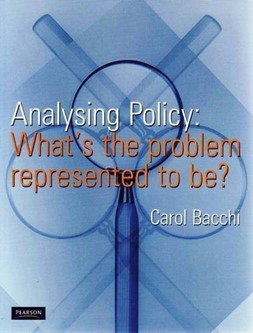
My multi-level policy study involved analysing policy documents with WPR, alongside interviews with policymakers, national stakeholders, and individuals with lived experience of being impacted by NHS-IVF restrictions. My project also involved collaborative WPR, a new method for involving people with lived experience in WPR analysis. More information on collaborative WPR is available in a recent Critical Policy Studies publication co-authored with Merissa Elizabeth Hickman, entitled Integrating co-analysis and researcher reflexivity into Bacchi’s ‘What is the Problem Represented to Be?’ Framework: A cervical screening case study: https://doi.org/10.1080/19460171.2025.2561142.
Biographical narrative interviews were conducted to understand the real effects of restrictions on people’s lives. I found this interview method to be an enlightening way to explore subjugated knowledges and the long-term lived impact of policies. I developed a pragmatic Foucauldian-inspired narrative framework that bridges narrative, corporeal, and post-structural concepts to explore lived effects, and I hope to share this work soon.
Now, I am considering how WPR can incorporate feminist new materialisms, including corporeality and embodiment, to understand how bodies are marked, inscribed, pushed, and pulled by the technologies of government. My study examined how statistics and scientific evidence used in policy can function as dividing practices, producing ‘truths’ about bodies as individually controllable, stable, and predictable, while making invisible the materiality and volatility of flesh. I hope to work with concepts which problematise the nature of the subject/body ‘relationship’, such as Bacchi and Beasley’s social flesh.


 Critical Policy Conversations
Leave a comment