
Carol Bacchi is Professor Emerita of Politics at Adelaide University, Australia. Bacchi is best known for her approach to policy analysis called “What’s the Problem Represented to be?” or the WPR approach. She researches and writes primarily in feminist political theory and policy theory. Her current work explores possible innovations in and extensions of “WPR thinking”.
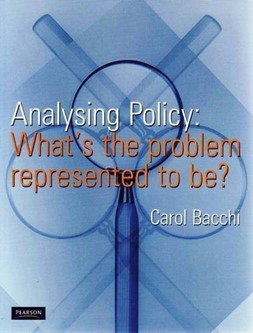
My WPR journey can be traced to the mid-1990s and my work on affirmative action, which analysed how the reform was represented differently in six countries. Influenced by feminist theorists such as Sandra Harding and Genevieve Lloyd, I next produced a study of how some selected issues targeting women’s “inequality” were represented, including domestic violence, education and abortion. Between this study and the 2009 book, Analysing Policy: What’s the Problem Represented to be?, I shifted my analytic focus from interpretivism to performativity. The scope of application of WPR widened due to a broadened understanding of governing and of policy (see Bacchi and Goodwin 2016/2025). In a new book to be published by Routledge, I argue that WPR offers a new thinking paradigm, displacing problem solving, and putting in question a wide range of terms commonly postulated as drivers of social change – e.g. “issues”, “difficulties”, “crises” and “matters of concern”. The new book illustrates how WPR can be deployed in literature reviews and focus reviews, and to analyse concepts.
In addition to the 1999 book, I have produced applications of WPR in alcohol and other drug policy in 2015, and in music education policy (2023). The former identifies underlying presuppositions within the category “alcohol problems” and their political and ethical implications. The latter raises critical questions about the representation of “music” as a body of knowledge to be taught by the “musically literate”, understood to be someone fluent in standard Western notation. A chapter in a recent Handbook on Governmentality illustrates how WPR goes “behind” “policies” and directs attention to the knowledges that make specific problematizations possible, the genealogy of their development and their effects.
In future research I hope to develop theoretical interventions to give effect to some key terms in the WPR questions: “presuppositions”, “silences”, “subjectification” and “self-problematisation”. I also intend to consider in some detail how WPR operates as a reform strategy and its possible uses in the context of authoritarian regimes.



 Critical Policy Conversations
Leave a comment