We are currently organising a Special Issue on the WPR (What’s the Problem Represented to be?) approach for the International Review of Public Policy. If you are interested in contributing, or if you have any questions, please don’t hesitate to contact one of the guest editors: Rebecca Muir (r.l.muir@qmul.ac.uk), Merissa Elizabeth Hickman (meh48@leicester.ac.uk), and Laura Bea (leb3g16@soton.ac.uk).
Using post-structural policy analysis to disrupt knowledge and power hierarchies
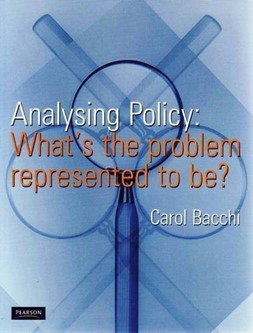
‘What’s the Problem Represented to be’ (WPR) is an approach developed by Carol Bacchi that aims to challenge the conventional view that public policies are responses or reactions to problems that sit outside the policy process, waiting to be discovered and solved. The key question Bacchi asks is: “What’s the problem represented to be?”. Central to this question is unpacking the ways solutions and problems are constituted. By limiting the range of possible solutions, and restricting the type of evidence considered legitimate , traditional policy approaches can encourage a policymaking space that may end up reproducing the same problems it seeks to ‘solve’. By questioning ‘taken for granted’ assumptions and mapping the history of the present, WPR aids in the examination of policy ‘problems’ and offers alternative ways of thinking.
However, research using this approach has not conventionally incorporated diverse knowledge-producers, collaborative analysis techniques, or lived experience. Analysis from different vantage points can create a politically and socially relevant WPR analysis which has transformative potential.
This special issue aims to surface and explore how WPR can be used and actioned as a transformative tool to disrupt knowledge/power hierarchies and surface new conversations. We particularly interested in papers answering the questions:
How can the WPR framework expand and develop to include more diverse perspectives on policy, including lived experiences?
How can researchers utilising WPR explore the lived effects of a policy using diverse forms of data and evidence?
Can ‘WPR-thinking’ be mobilised in policymaking settings and open up political discourse on key policy issues of our time?
In what ways has WPR been combined with other approaches – including participatory, discourse analysis, and other critical approaches, and what tensions and opportunities emerge?

 Critical Policy Conversations